AI can write a feature in minutes. The harder question, the one that decides whether a client trusts the result, is whether that feature actually does what it should. A model will happily produce code that compiles, looks right in review, and quietly returns the wrong thing in production. Closing that gap is most of the work now, and it is where a lot of "AI-built" projects fall apart after handoff.
The technique that has formed around closing it has a name this year: loop engineering. Here is what it is, and how we use it so the code we ship is verified, not just plausible.
Where the idea comes from
The vocabulary built up in layers. Andrej Karpathy made the case for "context engineering," getting the right information in front of the model at the right moment, over one-shot "prompt engineering." Then the people running agents at scale pushed it further. Boris Cherny, who built Claude Code at Anthropic, describes not prompting the model by hand anymore, but running loops that prompt it and decide what to do next. The common shape: stop driving the agent turn by turn, and design the system that drives it for you.
For an agency, that shift matters for one reason. A loop that runs without a human in the middle is only safe to use on client work if it can prove its own output. That proof is the part most teams leave out.
The four parts of a loop
A loop is the structure that lets an agent do work without being re-prompted at every step. It has four parts.
A memory it reads before it acts and writes back to after. A set of rules it cannot break. A verifier that confirms the output before it counts. And a schedule that triggers the whole thing. Memory, rules, verify, schedule.
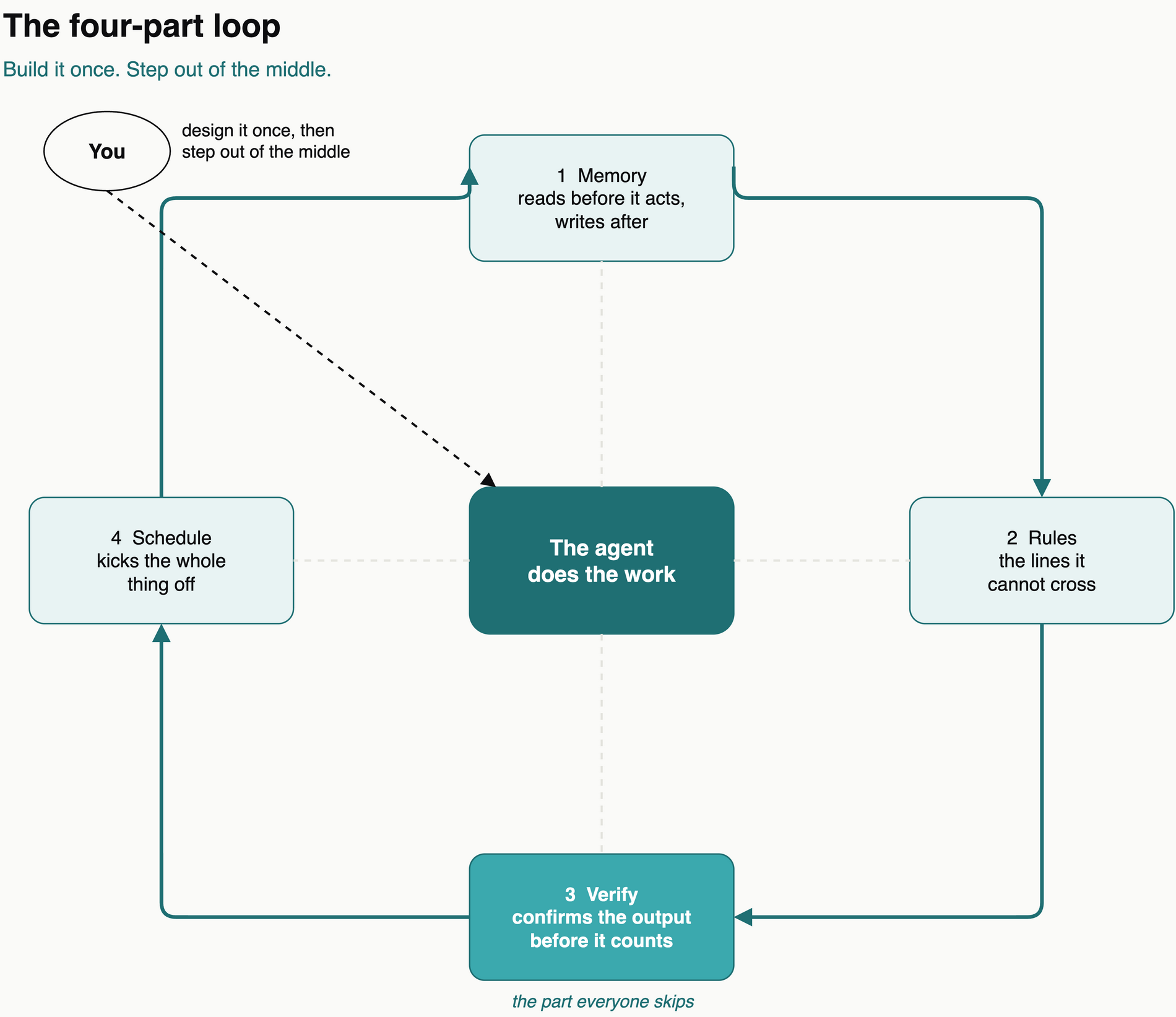
The first three are easy to assemble. The fourth is the one that separates a tool you can leave running from a tool you have to babysit.
How it looks on a real build
Take a normal task on a client web app: add an endpoint that the front end depends on. We write the goal as something a machine can check, not a vibe.
Goal: add a /health endpoint.
Done when:
- GET /health returns 200
- the response body is {"status":"ok"}
- the test suite passes and the build succeeds
The agent reads the project's memory and rules, adds the route, and reports it finished. Then a separate checker, with no stake in the code passing, runs each condition literally. On the first pass it finds the endpoint returns the wrong shape, {"ok":true} instead of {"status":"ok"}. Compiles fine. Would have broken a consumer downstream and surfaced days later. The checker catches it in seconds, the failure becomes a new rule so it cannot recur, and the next pass is clean.
Nothing exotic happened there. The difference is that the result was confirmed against a contract before anyone called it done. Multiply that across a project and it is the difference between an AI-built codebase that holds up after handoff and one that quietly accumulates issues the client finds for you.
The part most teams skip
The verifier is the piece that gets left out, and it is the one that matters most. Memory, rules, and a schedule give you a system that produces a lot of code. They do not give you code anyone should ship unseen. Without a verify step you do not have a loop you can trust, you have a very confident junior developer running on a timer.
This is also where "we use AI" stops being a slogan and becomes a standard. Anyone can generate code quickly. The work we actually sell is the judgment about what counts as done, encoded into a check the machine has to pass every time.
How we work with it
We build with these loops where they make a project faster without making it riskier, and we keep a person accountable for the parts that need judgment: what the goal is, what the rules protect, and what the verifier must prove. The agent moves quickly inside those guardrails. We stay responsible for the result.
If you are building a web or 3D product and want it built with AI without inheriting the mess that usually comes with it, that is the kind of work we do at CasaInnov. The speed is the easy part. The standard is the point.